

Self Construction vs Turnkey Construction Architects in YEIDA: Which Is Better for Your Dream Home?

Planning to construct a house on your residential plot in YEIDA (Yamuna Expressway Industrial Development Authority)? One of the first decisions you need to make is whether to choose self construction or turnkey construction.
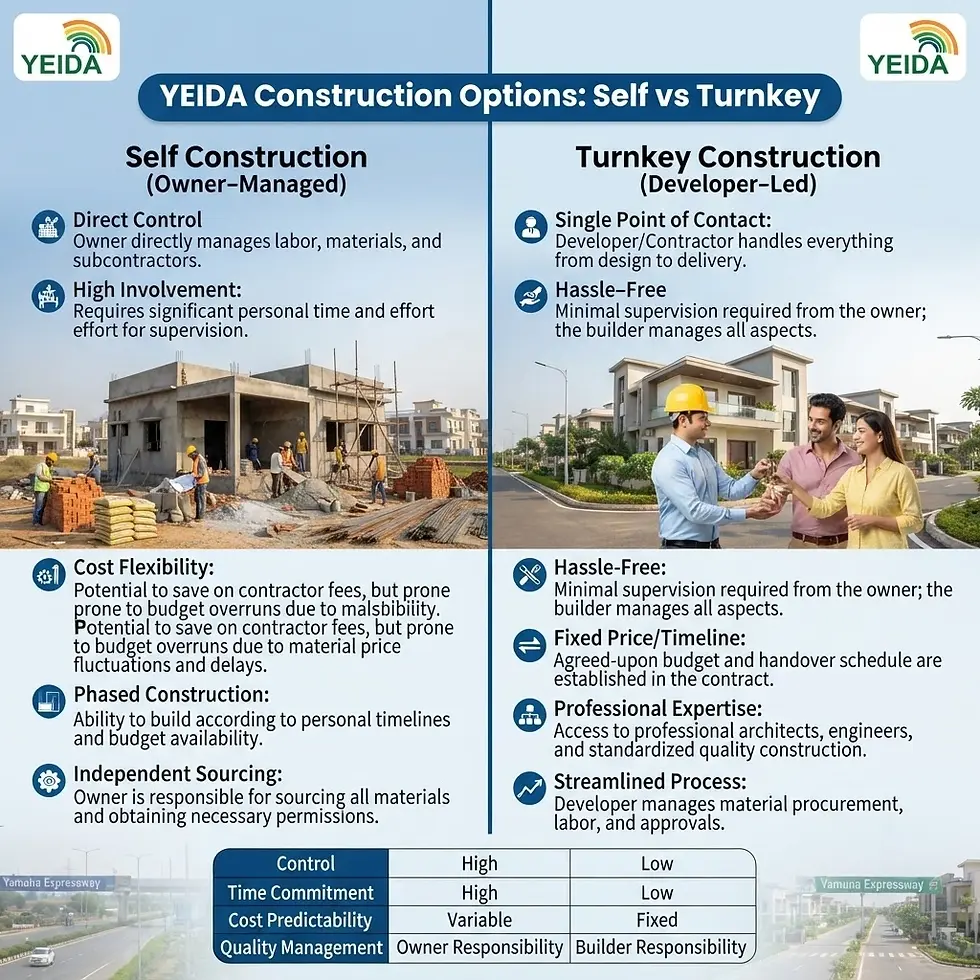
Both construction methods have advantages and disadvantages. In self construction, the plot owner manages different contractors, materials, labour, and site activities. In turnkey construction, a construction company takes responsibility for delivering the agreed construction work according to the contract, specifications, and payment schedule.
Choosing the right approach can make a significant difference to your construction budget, project management responsibilities, quality control, and overall experience.
Professional Architects in Yeida can help homeowners understand both options, prepare architectural drawings, plan construction costs, and make informed decisions before starting work.
Shahwalia Architect is a Construction and Architecture Company serving Delhi, Noida, and YEIDA. This guide compares self construction vs turnkey construction in YEIDA so you can select the approach that suits your requirements.
1. What Is Self Construction in YEIDA?
Self construction means the property owner manages the house construction process independently by appointing different contractors, labour teams, suppliers, and technical professionals.
Under this arrangement, the owner generally takes responsibility for coordinating the complete project, from foundation work to finishing.
For example, a homeowner may appoint:
An architect for house design and planning.
A structural engineer for structural drawings.
A civil contractor for construction work.
Separate teams for electrical and plumbing work.
Tile, painting, and finishing contractors.
Suppliers for cement, steel, bricks, and other materials.
The owner coordinates these activities and monitors the project budget, material purchases, labour payments, and construction progress.
Advantages of Self Construction
1. Greater control over material selection
You can personally select cement, steel, bricks, tiles, sanitary fittings, electrical products, and finishing materials according to your preferences and budget.
2. Flexible budget management
You can divide the construction into different stages and make purchasing decisions according to the available funds.
3. Direct contractor selection
You can appoint individual contractors and suppliers after comparing their quotations, experience, and quality of work.
4. Greater involvement in construction
If you have sufficient construction knowledge and time, you can directly monitor site activities and make decisions throughout the project.
Disadvantages of Self Construction
Self construction also involves significant responsibilities.
Requires regular site supervision.
Demands time for contractor coordination.
Requires knowledge of construction materials and workmanship.
Material wastage may increase project costs.
Different contractors may disagree about responsibilities.
Poor coordination can delay construction.
Quality control becomes the owner's responsibility.
Self construction may be suitable for homeowners who have construction experience, reliable technical support, and enough time to manage the project.
2. What Is Turnkey Construction in YEIDA?
Turnkey construction is a construction arrangement in which a company agrees to complete a defined scope of construction work and hand over the completed building to the owner according to the contract.
The construction company generally manages labour, material procurement, site execution, and coordination within the agreed scope.
The owner deals primarily with one main contractor rather than independently managing multiple construction teams.
Depending on the agreement, turnkey construction may include:
Foundation and structural construction.
Brickwork and plastering.
Electrical and plumbing work.
Flooring and tiling.
Doors and windows.
Painting and finishing.
Selected fixtures and fittings.
Site coordination and supervision.
The exact scope differs between companies. Some turnkey packages include architectural and structural design, while others require the owner to provide approved drawings separately.
Advantages of Turnkey Construction
1. Single-point project coordination
The owner has one main construction company responsible for coordinating the agreed work.
2. Better time management
The contractor manages labour and material coordination, which can reduce the owner's day-to-day involvement.
3. Defined construction scope
A detailed contract can establish material specifications, work quantities, payment stages, exclusions, and responsibilities.
4. Easier budget planning
An agreed contract price or clearly defined rate structure can make financial planning easier, subject to variations and exclusions.
5. Reduced daily supervision
The construction company manages routine site operations, although the owner should still arrange independent inspections and quality checks.
Disadvantages of Turnkey Construction
The initial quoted amount may be higher than an incomplete self-construction estimate.
Material specifications may be limited by the selected package.
Additional work can increase the final price.
Quality depends on the contractor's execution and supervision.
Changes after contract signing may involve additional costs.
Poorly written contracts can create disputes.
A turnkey contract should clearly define the scope, quality standards, payment milestones, completion conditions, and defect-liability responsibilities.
3. Self Construction vs Turnkey Construction: Key Differences
Both methods can deliver a good-quality home when planned and executed properly. However, their management structures are different.
Comparison | Self Construction | Turnkey Construction |
Project management | Owner manages contractors | Main contractor manages agreed work |
Material purchasing | Generally managed by owner | Generally managed by contractor |
Labour coordination | Owner's responsibility | Contractor's responsibility |
Budget control | Direct purchasing control | Based on contract and variations |
Site supervision | Requires regular owner involvement | Contractor supervises routine work |
Design flexibility | Generally flexible | Depends on contract |
Contractor coordination | Multiple teams | One main contractor |
Quality monitoring | Owner arranges checks | Contractor manages execution; owner should verify |
Time management | Depends heavily on coordination | Contractor coordinates the agreed schedule |
Best suited for | Experienced and involved owners | Owners seeking managed execution |
The best option depends on the homeowner's available time, construction knowledge, budget, and preferred level of involvement.
4. Which Construction Method Is More Economical in YEIDA?
Cost is one of the biggest considerations when planning a house in YEIDA.
Many homeowners assume self construction is always cheaper because they purchase materials directly. Similarly, some assume turnkey construction is expensive because it includes contractor management.
Neither assumption is universally correct.
Self Construction Cost Factors
The overall cost may include:
Cement, steel, bricks, sand, and aggregates.
Labour and contractor charges.
Structural and architectural consultancy.
Electrical and plumbing materials.
Flooring and finishing.
Transportation and material handling.
Equipment and scaffolding.
Site supervision.
Material wastage and rework.
Contingency expenses.
Direct purchasing can help control material selection, but poor estimation, wastage, and coordination problems may increase the final expenditure.
Turnkey Construction Cost Factors
A turnkey quotation may include:
Materials and labour.
Construction management.
Site supervision.
Contractor overheads.
Equipment and handling.
Defined finishing specifications.
Contractor profit.
Other agreed project expenses.
Before comparing quotations, homeowners should check whether both estimates cover the same construction scope and quality specifications.
Important: Always compare costs on the basis of the proposed built-up area and identical specifications, not simply the plot area.
5. Quality Comparison: Self Construction vs Turnkey
Construction quality depends on the quality of materials, workmanship, supervision, technical drawings, and execution practices.
In self construction, the owner has more direct control over purchases but must also verify that materials are used correctly.
In turnkey construction, the contractor coordinates the execution, but the owner should establish clear quality standards and independent inspection arrangements.
Important Quality Checks
Foundation and reinforcement inspection.
Concrete mix and quality control.
Structural drawing compliance.
Brickwork alignment and plaster quality.
Waterproofing and drainage.
Electrical wiring and safety.
Plumbing and pressure testing.
Flooring and finishing workmanship.
Door and window installation.
Hiring an independent engineer or qualified professional for periodic inspections can be useful under either construction model.
6. Which Option Saves More Time?
Time management is another important difference.
Self construction can take longer when the owner has to coordinate different contractors, arrange materials, resolve site issues, and schedule individual work teams.
Turnkey construction can simplify coordination because one contractor manages the agreed execution activities.
However, turnkey construction does not automatically guarantee faster completion.
Actual project duration depends on:
Design finalisation.
Applicable building plan approval.
Site conditions.
Availability of materials.
Labour availability.
Weather conditions.
Project size and complexity.
Changes requested during construction.
Contractor planning and performance.
Homeowners should request a realistic project schedule with stage-wise milestones rather than relying only on verbal completion promises.
7. YEIDA Building Plan Approval: An Important Step Before Construction
Whether you choose self construction or turnkey construction, applicable building plan approval requirements must be addressed before starting construction.
Construction arrangements do not replace authority approvals.
Before beginning work, homeowners should verify:
Residential plot category and allotted land use.
Plot dimensions and orientation.
Applicable FAR.
Ground coverage.
Front, rear, and side setbacks.
Permitted building height and floors.
Parking requirements.
Staircase and access provisions.
Required architectural and structural drawings.
Current YEIDA submission and approval requirements.
The applicable requirements can vary according to plot category and current authority regulations.
Professional Architects in Yeida can assist with architectural planning, 2D floor plans, 3D elevations, and preparation of building plan approval drawings.
The owner should ensure that construction follows the sanctioned plan and applicable conditions.
8. How to Select the Right Turnkey Construction Company in YEIDA
Choosing the right construction company is essential because the contractor will be responsible for executing an important investment.
Before signing a turnkey agreement, check the following:
1. Previous construction projects
Review completed residential projects and, where possible, visit actual construction sites.
2. Detailed material specifications
Check the proposed brands, grades, dimensions, and quality specifications for cement, steel, electrical products, plumbing materials, tiles, and fittings.
3. Written scope of work
Confirm exactly what is included and excluded in the contract.
4. Payment schedule
Payments should be linked to clearly defined construction milestones.
5. Completion timeline
Ask for a realistic schedule and provisions for delays or extensions.
6. Quality inspection arrangements
Clarify how reinforcement, concrete, waterproofing, electrical, and plumbing work will be inspected.
7. Additional work policy
Understand how design changes, additional quantities, and upgrades will be priced.
8. Warranty and defect-liability terms
Check the contractor's written responsibility for defects and repairs after handover.
A transparent contract is more important than selecting a contractor only because of a low quotation.
9. Which Construction Method Is Better for Different Homeowners?
The right choice depends on the owner's priorities.
Choose Self Construction If:
You have sufficient time for site supervision.
You understand construction materials and processes.
You have reliable contractors and technical professionals.
You want direct control over material purchases.
You can coordinate multiple work teams.
You are comfortable managing project responsibilities.
Choose Turnkey Construction If:
You have limited time for daily site management.
You prefer one main construction coordinator.
You want a clearly documented construction scope.
You prefer milestone-based payments.
You want the contractor to manage routine procurement and labour coordination.
You are comfortable working within agreed specifications.
Consider a Hybrid Construction Model
Some homeowners prefer a combination of both methods.
For example, the owner may appoint Shahwalia Architect or another architectural professional for design and planning, while hiring a separate contractor for construction execution.
Alternatively, the owner may directly purchase selected materials while assigning defined construction activities to a contractor.
A hybrid model can provide a balance between control and professional coordination, provided responsibilities are clearly documented.
10. Why Hire Architects in Yeida Before Choosing a Construction Method?
Many homeowners approach contractors before finalising their architectural requirements. This can create confusion about construction quantities, specifications, budget, and approval conditions.
An architect can help establish a proper design and technical foundation before the construction contract is signed.
Shahwalia Architect provides services such as:
Residential architectural planning.
2D house floor plan design.
3D front elevation design.
Duplex and modern house design.
Space planning.
YEIDA building plan approval drawing assistance.
Construction cost estimation.
Architectural and structural coordination.
Construction consultancy.
With a clear architectural design and defined scope of work, homeowners can compare self-construction estimates and turnkey quotations more accurately.
Frequently Asked Questions (FAQs)
1. What is the difference between self construction and turnkey construction in YEIDA?
In self construction, the owner manages contractors, labour, materials, and site activities. In turnkey construction, a main contractor manages the agreed construction scope and hands over the completed work according to the contract.
2. Is self construction cheaper than turnkey construction?
Not always. Self construction may offer direct purchasing control, but labour coordination, material wastage, delays, and rework can increase costs. Turnkey construction includes contractor management costs but may provide a more structured budget.
3. Is turnkey construction better for first-time homeowners?
It can be suitable for first-time homeowners who have limited construction knowledge or time for daily site management. However, they should carefully review the contractor's experience, specifications, contract, and quality-control arrangements.
4. Does turnkey construction include architectural design?
It depends on the agreement. Some companies include architectural and structural design, while others provide only construction execution. Always confirm the scope in writing.
5. Who purchases construction materials in turnkey construction?
Generally, the contractor purchases materials included in the contract. However, the responsibility may differ according to the agreement.
6. Do I need YEIDA building plan approval before construction?
Homeowners must follow the applicable YEIDA building plan approval requirements and obtain the necessary approval before starting construction.
7. Can I hire an architect separately for turnkey construction?
Yes. You can appoint an independent architect for design, planning, and drawing coordination while hiring a separate contractor for construction execution.
8. How can I compare turnkey construction quotations?
Compare the built-up area, material brands, specifications, labour, finishing scope, exclusions, payment schedule, taxes, additional work rates, and completion conditions.
9. Which construction method offers better quality?
Neither method automatically guarantees better quality. Quality depends on technical planning, materials, workmanship, site supervision, and inspection arrangements.
10. Does Shahwalia Architect provide construction consultancy in YEIDA?
Shahwalia Architect provides architectural planning, 2D floor plans, 3D elevations, YEIDA building plan approval drawing assistance, construction cost estimation, and construction consultancy.
Contact Shahwalia Architect
Planning to construct your dream home in YEIDA and confused between self construction and turnkey construction?
Get professional guidance for architectural planning, house design, construction estimates, and building plan approval drawing assistance.
Shahwalia ArchitectConstruction and Architecture Company in Delhi, Noida, and YEIDA
Phone: 9811169778
Email: shahwaliaarchitect@gmail.com
Website: https://www.shahwaliaarchitect.com/
Contact Shahwalia Architect to discuss your residential plot, architectural requirements, and construction planning.
Conclusion
Choosing between self construction and turnkey construction in YEIDA depends on your budget, available time, construction knowledge, and preferred level of project involvement.
Self construction offers greater direct control over materials, contractors, and purchasing decisions but requires active management. Turnkey construction offers centralised coordination and a defined scope of work, but homeowners must carefully examine the contract, specifications, exclusions, and quality standards.
Before selecting either option, finalise your architectural drawings, understand the applicable YEIDA building regulations, and prepare a realistic construction estimate.
Professional Architects in Yeida, such as Shahwalia Architect, can help homeowners plan their projects with better design coordination and informed construction decisions.


Comments